Malaysia Employment Pass 2026: The New June 1st Salary Rules Explained
If you’ve got your sights set on the Asian Tiger economy or you’re plotting to scale your operations in Kuala Lumpur this year, the ground just shifted beneath your boots. As of June 1st, 2026, the Malaysian government has officially pulled the trigger on a brutal overhaul of the Malaysia Employment Pass (EP) framework. This isn’t some minor adjustment to the fine print; it’s a high-stakes strategic pivot designed to cherry pick high value global talent while forcing a massive wave of local workforce upskilling.
Whether you’re wrestling with the ESD (Expatriate Services Division) or the tech focused MDEC Expatriate Services portal, flying blind is no longer an option. In the cutthroat 2026 landscape, mastering these new salary thresholds is the razor-thin line between a seamless approval and a soul crushing rejection. If you aren’t braced for the June 1st Shock, your entire migration strategy is liable to hit a brick wall before you even clear the first interview.
1. The June 1st Salary Revision: Why the sudden change?
The June 1st Salary Revision didn’t happen in a vacuum. It was introduced to bridge the gap between hiring expatriates and the actual economic reality of Malaysia in 2026. The Ministry of Human Resources, working hand-in-hand with the MYXpats Centre Malaysia, has effectively raised the bar for who can be called a Foreign Knowledge Worker (FKW).
The core logic? The government wants to ensure that the Minimum Salary Threshold 2026 isn’t just a number, but a reflection of the rare, high demand skills found in the Critical Occupations List (COL). Employers can no longer hire “cheap” foreign talent; they must now prove that the expatriate brings a level of mastery that justifies a premium wage compared to local talent.
2. The New Tier System: EP Category I, II, and III
The 2026 framework has turned the old tier system into a much more rigid structure. If you’re an HR manager or a professional planning your relocation, these categories are now your Bible.
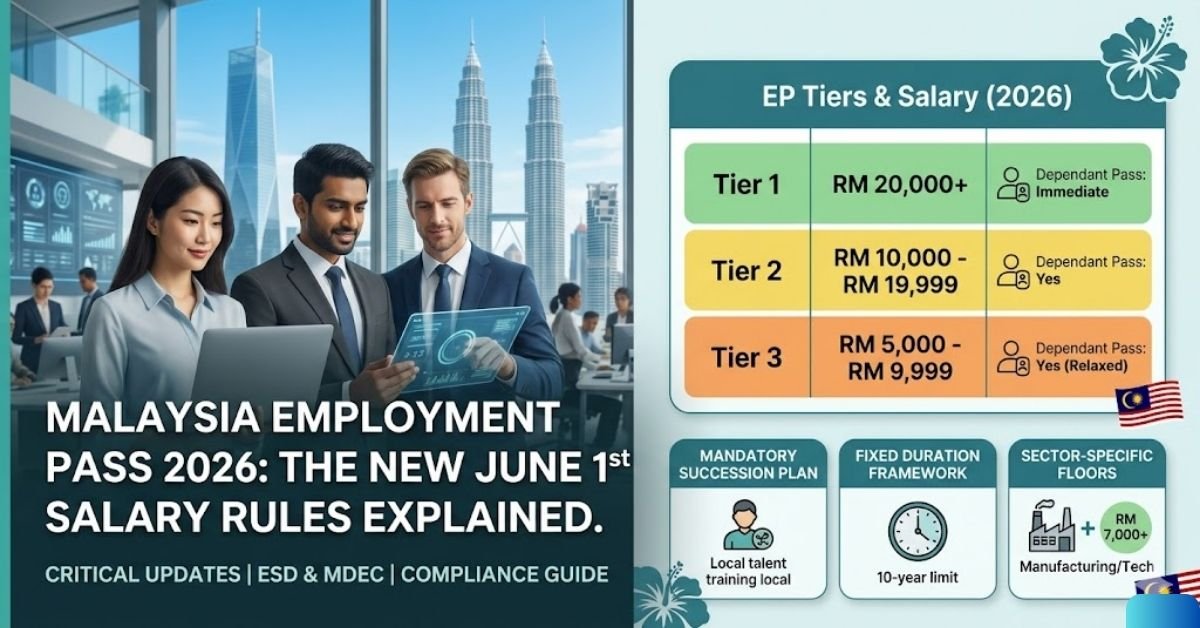
2026 Employment Pass Category Comparison Table
| Category | New Salary Threshold (RM) | Tenure Cap | Dependant Pass Eligibility |
| EP Category I | RM 20,000+ | 10-Year Cap | Yes (Immediate Approval) |
| EP Category II | RM 10,000 – RM 19,999 | 10-Year Cap | Yes |
| EP Category III | RM 5,000 – RM 9,999 | 5-Year Fixed Tenure | Yes (New Relaxation for 2026) |
Pro Tip: Here is the Golden Hack for 2026: Dependant Pass Eligibility for Category III has been significantly relaxed. Mid-level technical experts can now bring their families, provided they hit the RM 7,000 floor in specific high-growth sectors. This is a massive win for those who felt stuck in the Single Status trap previously.
3. The Stealth Update: Mandatory Succession & Replacement Plans
One of the most talked-about stealth updates in the June 1st rollout is the Mandatory Succession Plan. For every single Employment Pass issued, the sponsoring company must now submit a detailed Knowledge Transfer Roadmap.
Local Workforce Upskilling: This isn’t a suggestion anymore. Companies must provide documented proof that they are actively training at least two Malaysian employees to eventually inherit the expatriate’s role.
Mandatory Replacement Plan: When you go for an Employment Pass Renewal Policy request for Category II or III, the authorities will demand a progress report. If you haven’t shown genuine upskilling progress for your local successor, your renewal will likely be denied.
4. Sector Specific Floors: Manufacturing & Tech Deep Dive
The 2026 rules don’t treat every industry the same. Depending on where your office is located, the “Floor” might be higher than you think.
Manufacturing Sector Salary Floor
To prevent the undercutting of local engineering graduates, the Manufacturing Sector Salary Floor is now locked at a strict RM 7,000 for any engineering or specialised technical role. Even if Category III starts at RM 5k, the manufacturing sector won’t let you sponsor an expat for anything less than seven grand.
Malaysia Tech Visa Requirements
Under the Digital Economy Corporation (MDEC), the Foreign Knowledge Worker (FKW) Strategy remains the most flexible path, but it comes with a price. Paid up Capital Requirements have been hiked. For example, tech startups now need a minimum of RM 500,000 in paid-up capital just to be eligible to sponsor a Category II expatriate.
5. The Fixed Employment Duration Framework (The 10-Year Wall)
The 2026 policy introduces a Fixed Employment Duration Framework that puts a hard stop on Forever Expats.
- 10 Year Tenure Cap (Category I & II): After a decade, you’ve reached the limit. You must either qualify for a Residence Pass Talent (RP-T) or leave the country for a mandatory cool off period.
- 5 Year Fixed Tenure (Category III): This tier is now explicitly a temporary bridge. The government expects you to either level up your skills to Category II status or move on after 5 years.
6. Your Step by Step 2026 Compliance Checklist
Don’t let the Malaysia Corporate Compliance Update catch you off guard. Follow this roadmap to stay in the clear:
- Audit the COL: Before even interviewing a candidate, check the Critical Occupations List. If the role isn’t available, your odds of approval drop by 50%.
- Attend ESD Briefing Sessions 2026: If you’re an HR pro, these monthly sessions at the MYXpats centre are vital. This is where unwritten processing shifts are discussed.
- Draft the Roadmap: Your Knowledge Transfer Roadmap should be ready before you open the ESD portal. It needs to be specific, not generic.
- Verify Paid up Capital: Ensure your company’s financials meet the new 2026 thresholds for the specific Category you are targeting.
7. FAQ: Clearing the 2026 Confusion
Q: My salary is RM 4,800. Can I still renew my Category III pass?
A: Absolutely not. The Minimum Salary Threshold 2026 is non negotiable. You have until your current pass expires to either get a raise to RM 5,000 or find a role that meets the new criteria.
Q: Is the 10-Year Cap per company or per person?
A: It is a cumulative limit per person. You cannot reset the clock by simply changing employers. Once you’ve spent 10 years on an EP in Malaysia, the cap applies.
Q: Does Platinum Status still exist?
A: Yes. Companies with Platinum Status in the ESD portal those who maintain an exceptional ratio of local to foreign staff still enjoy 24 hour fast track approvals for Category I applicants.
Conclusion: Adapting to a Mature Economy
The Malaysia Employment Pass 2026 updates are a clear signal: Malaysia is no longer just a cheap labor destination; it is a mature economy that is becoming highly selective about the talent it imports. While the New Salary Rules for Expats are undeniably higher, they offer a more stable, protected, and family friendly environment for those who make the cut.
The era of the free for all migration is over. 2026 is about Expatriate Workforce Planning that serves the national interest while rewarding the world’s best talent.
Call to Action: Are you struggling to cut through the noise of these new June 1st rules for your specific industry? Don’t let the red tape stall your career. Drop a comment below and spill your situation our community is here to help you navigate the ESD and MDEC maze without the usual headaches. Stay ahead of the high stakes 2026 shifts and subscribe to our newsletter to get the latest immigration alerts delivered straight to your inbox.
Disclaimer:
This guide is built for raw insight, not as a replacement for professional legal or migration advice. Malaysia’s 2026 visa rules shift like the tides, so don’t burn your hard-earned cash without verifying the latest facts on the official ESD or MDEC portals first. We aren’t a visa agency, we don’t sell jobs, and your success depends 100% on the surgical precision of your own paperwork.