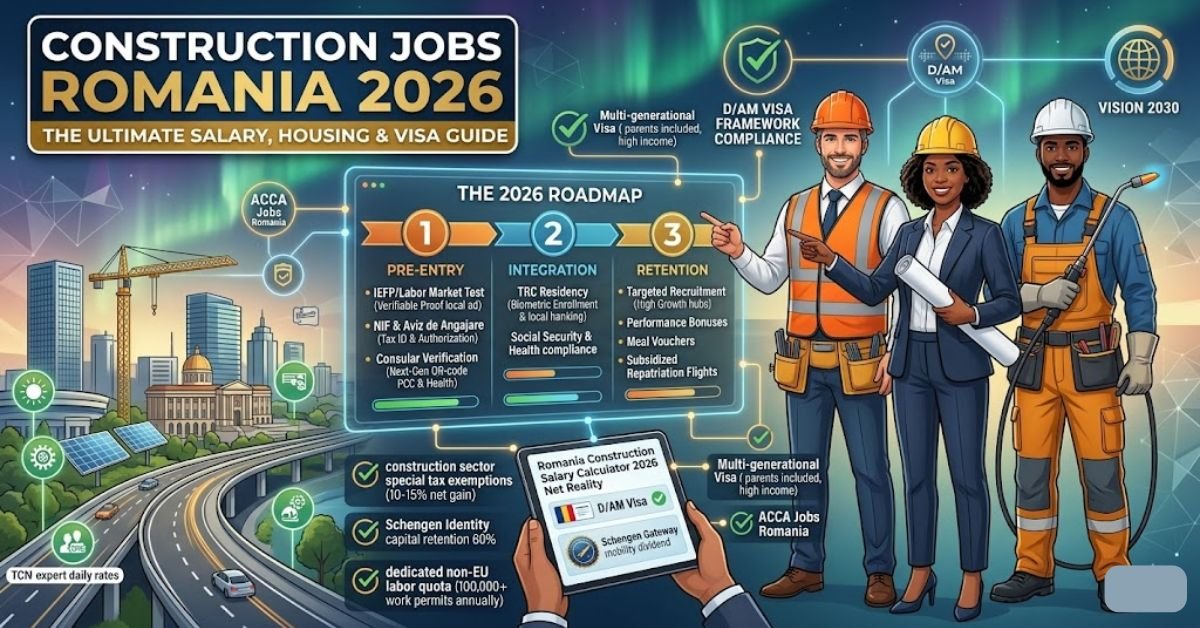
Construction Jobs in Romania 2026: The Ultimate Salary, Housing & Visa Guide
By 2026, Romania will have emerged as a high velocity Schengen Gateway, fueled by a historic €28.5 billion EU fiscal injection that is physically rebuilding the nation. This massive infrastructure boom has created the European Union’s most acute labor deficit, turning the country into a primary destination for global construction talent.
For professionals exiting stagnant markets, navigating this landscape requires a clinical understanding of the modernized 2026 Visa Architecture and fiscal reality. This guide offers an unfiltered look at how to secure a legitimate professional anchor within the heart of Europe’s most lucrative new trade frontier.
1. The 2026 Romania Labor Market: A Macro Economic Shift
The 2026 industrial landscape is currently navigating what economists describe as The Great Labor Vacuum. After decades of domestic talent migrating toward Western Europe, Romania is facing a critical internal shortage that has forced a total strategic pivot. To counter this, the Romanian government has formalized a Dedicated Non EU Labor Quota, issuing over 100,000 work permits annually. This is far more than a simple recruitment drive; it is a calculated, surgical initiative designed to import Infrastructure DNA from high caliber global talent pools to sustain the nation’s rapid growth.
The Schengen Mobility Dividend
By 2026, securing a Romanian work permit (specifically the D/AM Visa) has become a prestigious professional asset. Beyond the job itself, this permit establishes your Legal Footprint within the Schengen zone, granting you the freedom of frictionless travel across 29 European nations. More significantly, it calibrates your professional profile against rigorous EU Labor Standards. For the ambitious expat, this isn’t just a temporary role it is a strategic move that positions you as a prime candidate for elite, senior-level positions across the continent in the coming years.
2. Romania Construction Salary Guide 2026 The Net Reality
Deciphering your compensation in Romania requires a fundamental shift from Gross Contract Value to Net Disposable Income. While Romania’s fiscal regime is traditionally progressive, the 2026 framework provides specialized Tax Exemptions for the construction sector. These incentives are specifically designed to curb labor attrition and ensure a steady flow of international expertise into the nation’s infrastructure projects.
2026 Wage Matrix Salary vs. Market Velocity
| Occupational Tier | Avg. Monthly Gross | Est. Net Take-Home | 2026 Market Velocity |
| Senior Civil Engineer | €2,500 – €3,800 | €1,650 – €2,500 | Critical (High Priority) |
| BIM/CAD Specialist | €1,800 – €2,600 | €1,200 – €1,750 | Emerging Tech |
| Heavy Machinery Operator | €1,300 – €1,900 | €900 – €1,300 | Very High |
| Structural Welder (TIG/MIG) | €1,200 – €1,700 | €850 – €1,150 | High Demand |
| Industrial Electrician | €1,100 – €1,600 | €780 – €1,100 | Steady Flow |
| General Construction Labor | €900 – €1,100 | €650 – €750 | Massive Volume |
The Fiscal Arbitrage in Construction Wages
In 2026, the Romanian government continues to uphold a unique Tax Relief Policy for construction professionals whose earnings exceed the national minimum threshold. This creates a significant Net Gain scenario. Effectively, a construction specialist takes home roughly 10 15% more liquid cash than a retail or hospitality worker on the same gross salary. This difference stems from reduced social contribution requirements (CAS/CASS), making the construction sector the most financially efficient entry point for non-EU expats.
3. The 2026 Visa Framework A Comprehensive Compliance Roadmap
Successfully securing a Romania D/AM Visa in 2026 demands more than just paperwork; it requires a deep understanding of current Administrative Protocols. The Priority Processing lane is no longer a default setting. Instead, it is a merit based advantage strictly limited to applicants whose sponsoring firms have an untarnished standing with the General Inspectorate for Immigration. To navigate this transition seamlessly, you must adhere to these three core regulatory pillars.
Pillar 1: The Pre Entry Authorization (Aviz de Angajare)
Your relocation journey begins long before the embassy stage. Your employer must first navigate a rigorous Work Authorization phase.
The 2026 Labor Market Test: Under new 2026 transparency mandates, Romanian authorities enforce a strict Local First policy. Employers must provide verifiable proof that the position was advertised domestically for 15 days without attracting a qualified EU/EEA candidate. Furthermore, any fiscal delinquency on the employer’s part will result in an immediate rejection of the authorization.
Pillar 2: Consular Verification & Technical Attestation
Once your authorization is granted, the mission moves to the Romanian Consulate. This stage is where Document Accuracy becomes your greatest asset.
- Next-Gen Verification (PCC): For 2026, manual background checks are being phased out. Your Police Clearance Certificate should feature a secure QR code for instant digital validation.
- Health Compliance: A high level medical diagnostic report is mandatory, ensuring you meet the public health standards required for long term European residency.
- Educational Equivalency: To unlock higher salary brackets, your trade certificates must be Apostilled. This process bridges the gap between your home country’s qualifications and the Romanian Educational Framework, legitimizing your expertise in the eyes of EU regulators.
Pillar 3: The TRC Residency Integration
Arrival in Bucharest is just the opening act. Within your first 30 days on Romanian soil, you must initiate the Temporary Residence Card (TRC) process. This involves a biometric enrollment that officially integrates you into the national system. Think of the TRC as your Schengen Access Key. It is the definitive document that authorizes your presence, enables you to open a local bank account, and secures your right to the national healthcare system.
4. Lifestyle Economics The 2026 Compensation Arbitrage
In the current Romanian construction landscape, savvy expats are looking beyond the basic hourly rate to focus on Net Capital Retention. By 2026, the industry standard has shifted toward a model where the employer internalizes the majority of a worker’s operational costs. This creates a unique fiscal arbitrage: your primary salary remains untouched by the usual European cost-of-living pressures, allowing for maximum remittance potential. Essentially, the Romanian market has become a high-savings zone for international talent.
Institutionalized Housing & Infrastructure
The era of substandard labor camps is over. Tier-1 contractors like Strabag and Astaldi have deployed a Quality First accommodation strategy. In 2026, Dedicated Institutional Housing is the norm, featuring modular apartment complexes and professionally managed hostels. These sites are fully integrated with high-speed connectivity, industrial-grade laundry systems, and rigorous 24/7 security. By eliminating rent and utility bills from your financial ledger, these firms effectively increase your take-home value without raising the tax bracket.
Subsistence Strategy: The 2026 Voucher Ecosystem
A critical component of the Romanian perk package is the Tichete de masă (Meal Voucher) system. To mitigate the 2026 inflationary trends, these vouchers have been recalibrated, providing workers with an additional €180 – €220 in monthly liquidity. Because these digital vouchers are hard-coded for use at massive retail chains like Lidl, Kaufland, and Carrefour, your grocery and daily sustenance expenses are effectively neutralized. This ensures that your base salary is preserved for long-term financial goals rather than daily survival.
Repatriation Frameworks & Loyalty Bonuses
To combat the high turnover rates in the Schengen zone, 2026 contracts now feature aggressive Retention Incentives. We are seeing a surge in Completion Milestones where workers receive a significant Project Bonus upon reaching specific contract phases. Furthermore, the inclusion of fully subsidized Annual Repatriation Flights is now a standard clause in high-tier agreements. This ensures that the professional journey between your home country and the Romanian site is not just legally protected, but financially subsidized.
5. High Demand Roles Where the 2026 Boom is Happening
The Green Building Revolution
Romania is pivoting toward sustainable infrastructure. HVAC Technicians and Solar Panel Installers on large scale commercial sites are seeing the highest percentage growth in wages this year.
The Civil Backbone
The A7 and A8 highway projects have created a permanent demand for Masons, Carpenters, and Formwork Experts. If you can read complex blueprints, your salary bracket moves into the Skilled Elite category immediately.
6. Strategic Job Hunting & Scam Neutralization
The 2026 recruitment market is flooded with Ghost Agencies. To protect your investment:
- Direct Procurement: Use the EURES portal or LinkedIn to find direct listings from Romanian firms.
- Agency Verification: Cross reference the agency’s license number with the ITM (Inspectoratul Teritorial de Muncă) database.
- Financial Transparency: Never pay for a Job Offer. In Romania, the employer is legally responsible for the costs associated with the work permit application.
7. FAQ Expert Insights for the 2026 Expat Workforce
Navigating the transition to a new labor market involves answering critical questions about financial viability and legal security. Here is the 2026 breakdown for prospective applicants:
Q: Is the 2026 Romania Minimum Wage viable for international workers?
A: In 2026, the gross minimum wage is only half the story. When you factor in the Sector-Specific Tax Exemptions for construction and the standard provision of free housing and meal vouchers, the math changes. For a single worker, a €700 net take-home salary functions with a Capital Retention Rate of nearly 60%. Since your primary overheads (rent and food) are neutralized, this savings potential now exceeds what is typically achievable in many high cost Gulf markets.
Q: What are the legal implications if my employment contract is terminated?
A: Under the 2026 Revised Labor Protocols, the Romanian government provides a security buffer for non-EU workers. If your contract is terminated, you are granted a 90 day Regulatory Grace Period. During this window, you can legally remain in the country to secure a new employer and transfer your sponsorship before your Temporary Residence Card (TRC) is subject to revocation. This protection is contingent upon a Clean Exit meaning the termination was not triggered by criminal activity or severe policy violations.
Final Verdict The 2026 Strategy
Romania in 2026 is a Pay to-Play talent market. It offers the perfect balance between European residency and a manageable cost of living. By focusing on Construction Jobs in Romania 2026, you aren’t just getting a job; you are investing in a Schengen Identity that will pay dividends for the rest of your career.
Disclaimer :
This 2026 intelligence report serves strictly for informative purposes and does not constitute legal migration or financial advice. All wage projections and visa protocols are based on current fiscal benchmarks and regulatory frameworks, and readers are encouraged to verify specific contract terms through official Ministry of Labor (ITM) channels to ensure compliance with the latest European Union mandates.