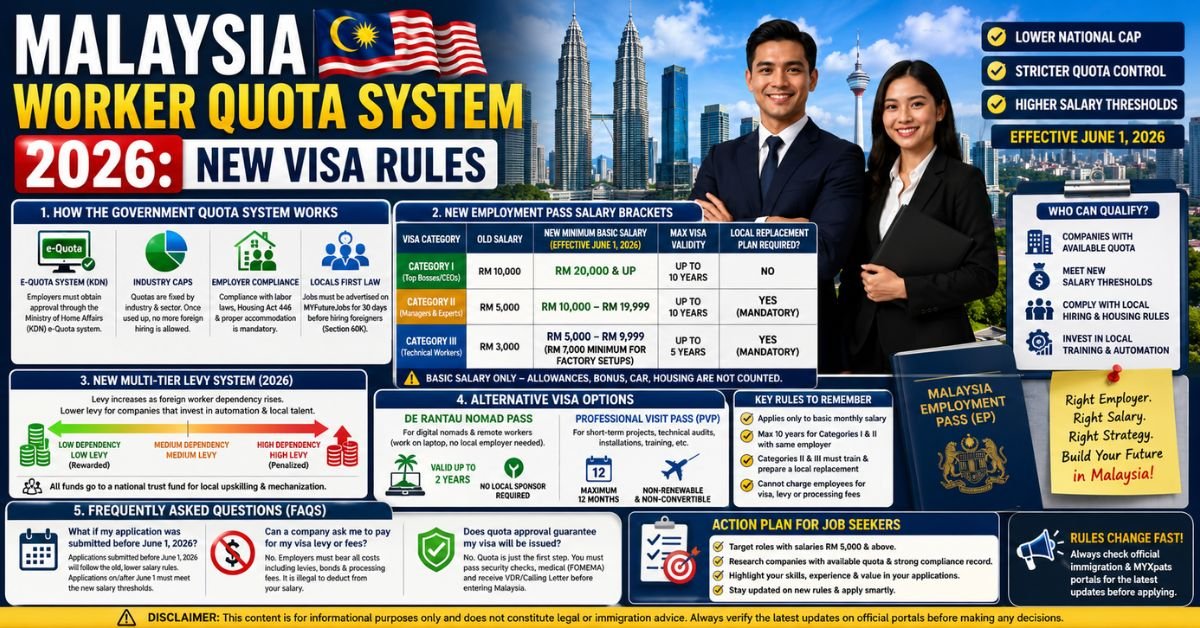
Malaysia Worker Quota System 2026: New Visa Rules
Hunting for a corporate job in Malaysia from overseas is getting pretty frustrating these days. You might clear all your interview rounds easily, but then the company suddenly freezes when it comes to processing your actual visa. Most candidates think the employer lost interest, but the real issue is the tight government quota system blocking them behind the scenes.
This year, the Malaysian government is strictly cutting down its reliance on foreign workers to hit a lower national cap. Because of this, authorities have completely changed how corporate hiring slots are given out while raising the minimum salary limits for outsiders. If you want to work there now, you have to target companies that still have the legal paperwork and space to bring you in.
1. How the Government Quota System Actually Works
Malaysian companies can’t just pick up the phone and hire anyone they want from another country. Before a boss can legally sign an employment contract with an international worker, they must get a green light from the state. The main platform handling this check is the online e Quota system run by the Ministry of Home Affairs (KDN).
If an employer wants to bring in technical staff or general labor through the standard PLKS work permit track, the authorities evaluate the business using very strict regional rules.
Things That Decide Your Approval:
- Industry Caps: The government divides hiring slots strictly by industry, focusing on things like factories, construction sites, plantations, farming, and specific service sectors. If a business burns through its designated sector limits, they are blocked from bringing in anyone else from abroad.
- The Employer’s Record: Getting approval depends heavily on how well the company follows local labor laws. For example, under the Housing Rule Act 446, a business must prove they provide decent, certified living quarters for foreign staff before they get a new slot.
- The Locals First Law: Under Section 60K of the local Employment Act, a company has to list their open vacancies on the official MYFutureJobs platform for a full 30 days. They have to keep a clear logbook showing they tried interviewing local citizens first but couldn’t find anyone qualified to take the spot.
2. Big Changes for Malaysia Employment Pass Salaries
If you are a manager, IT specialist, or senior professional, the ground rules for getting a white-collar visa are completely changing. The authorities have drastically updated the income rules for Category I, II, and III worker brackets, and these new rules come into full force very soon.
Basically, the minimum salary floors are jumping way up. If your contract doesn’t hit these new numbers, the immigration system will automatically reject your file. Here is how the new salary tiers look for the Employment Pass (EP):
The New Monthly Salary Brackets
| Visa Bracket Type | What the Salary Used to Be | New Minimum Basic Salary | Max Visa Validity | Do They Need a Local Replacement Plan? |
| Category I (Top Bosses / CEOs) | RM 10,000 | RM 20,000 and up | Up to 10 Years | No |
| Category II (Managers & Experts) | RM 5,000 | RM 10,000 to RM 19,999 | Up to 10 Years | Yes (Mandatory) |
| Category III (Technical Workers) | RM 3,000 | RM 5,000 to RM 9,999 (Note: RM 7,000 minimum for factory setups) | Up to 5 Years | Yes (Mandatory) |
Rules You Must Keep in Mind:
- Basic Pay Only: These minimum targets are calculated only on your basic monthly salary. Allowances, free housing, car stipends, or sales bonuses are completely ignored during the visa check.
- The 10-Year Cutoff: For Categories I and II, you can only stay with the same boss for a maximum of 10 years total. The government wants to ensure foreign talent doesn’t block local growth permanently. If you move to a new company, the timer resets.
- Training a Local Backup: For Categories II and III, the business has to upload a strict training schedule to the ESD visa portal. They must show exactly how and when they plan to train a local Malaysian worker to eventually take over your job.
3. The New Multi Tier Levy System: What It Costs Employers
To force corporate behavior away from cheap foreign labor, the government has introduced the highly anticipated multi-tier levy system for foreign workers in 2026. Instead of a flat, predictable tax per worker, the financial penalty scale climbs sharply based on how dependent a company is on non citizens.
If a manufacturing facility or hospitality group maintains a high percentage of foreign workers relative to their total headcount, their per-worker levy costs skyrocket. Conversely, businesses that actively invest in automated factory floors or local training modules are rewarded with lower levy bands.
All collected funds are funneled into a dedicated national trust fund to finance local technical upskilling and industrial mechanization. For you as an applicant, this means companies with weak automation or poor local hiring ratios face massive overhead costs, making them far less likely to sponsor foreign applications.
4. Other Ways to Work in Malaysia: Nomads and Short Visas
Since the regular company quotas and Employment Pass rules have become so tight, a lot of international applicants are skipping the standard job route entirely. Instead, they are looking at smart alternative setups managed by teams like MDEC and the MYXpats Centre.
The DE Rantau Nomad Route (No Boss Needed)
If your daily job lives entirely on your laptop like writing software, editing videos, designing web layouts, or managing remote data you can completely ignore the company quota system. By using the special DE Rantau freelance path, independent remote workers can move to Malaysia and live there for up to two full years. The best part is you don’t need a local Malaysian office or a corporate sponsor to back your file.
How the Professional Visit Pass (PVP) Works
If you are coming in for a quick project, like setting up a factory machine, doing a short technical audit, or doing short-term training, companies will usually skip the big visa and grab a Professional Visit Pass (PVP). Just remember the ground reality: this pass is locked at a maximum of 12 months. You cannot renew it when it ends, and you cannot swap it for a regular full time office visa while staying inside the country. It is strictly meant for consultants and engineers who want to finish a quick task and fly out.
5. Frequently Asked Questions (FAQs)
What happens if my job application was submitted before June 1, 2026?
Any new or renewal EP application successfully logged inside the ESD system before June 1, 2026, will be processed under the older, lower salary limits. However, any application filed on or after June 1 must meet the doubled salary floors there is absolutely no grace period for late submissions.
Can a company ask me to pay for my own visa levy or KDN processing fees?
Absolutely not. Under Malaysian labor laws, the employer is legally required to absorb all recruitment costs, including government levies, security bonds, and processing fees. It is highly illegal for an enterprise to deduct visa or levy costs from your monthly basic salary.
Does getting an approved worker quota guarantee that my visa will be issued?
No, securing a quota allocation from KDN is step one for the employer. Once the quota is granted, you must still clear individual security checks, submit medical results via FOMEMA, and receive an official Visa With Reference (VDR) or Calling Letter before you can enter the country to work.
Action Plan for International Job Seekers
With the Human Resources Ministry quota freeze Malaysia risks, and the massive June 2026 salary threshold doubling, your job search strategy must change immediately. Stop targeting entry level positions where salaries fall below RM 5,000, as companies will find it nearly impossible to justify those quotas under the new RMK 13 guidelines.
Disclaimer :
Everything shared on this page is to show you how the Malaysian work visa and company quota systems run. immigration updates, salary caps, and industry rules can change instantly, so always cross-check details on the official immigration or myxpats portals before taking any steps. We are just an informational site and do not give out jobs, work permits, or legal visa advice.