UK vs Canada vs Australia 2026: Which Country is Easiest for Work Visa Sponsorship?
Planning a move abroad in 2026? Let’s be real: it’s no longer about just pointing at a spot on the map. We’ve entered a high-stakes era where immigration rules change almost overnight. The Big Three the UK, Canada, and Australia have essentially torn up their old playbooks and started fresh this year. Whether you’re a coding expert, a healthcare pro, or a seasoned tradesperson, your easiest path now hangs on two brutal realities: your professional track record and the depth of your pockets.
In this no-nonsense breakdown, we’re stripping away the legal fluff to give you the raw, unfiltered truth. No sugar coating just a clear look at where you can realistically nail down a job and a visa in 2026 without burning through your life savings or wasting months in a backlog.
1. The United Kingdom: The Pay for Speed Strategy
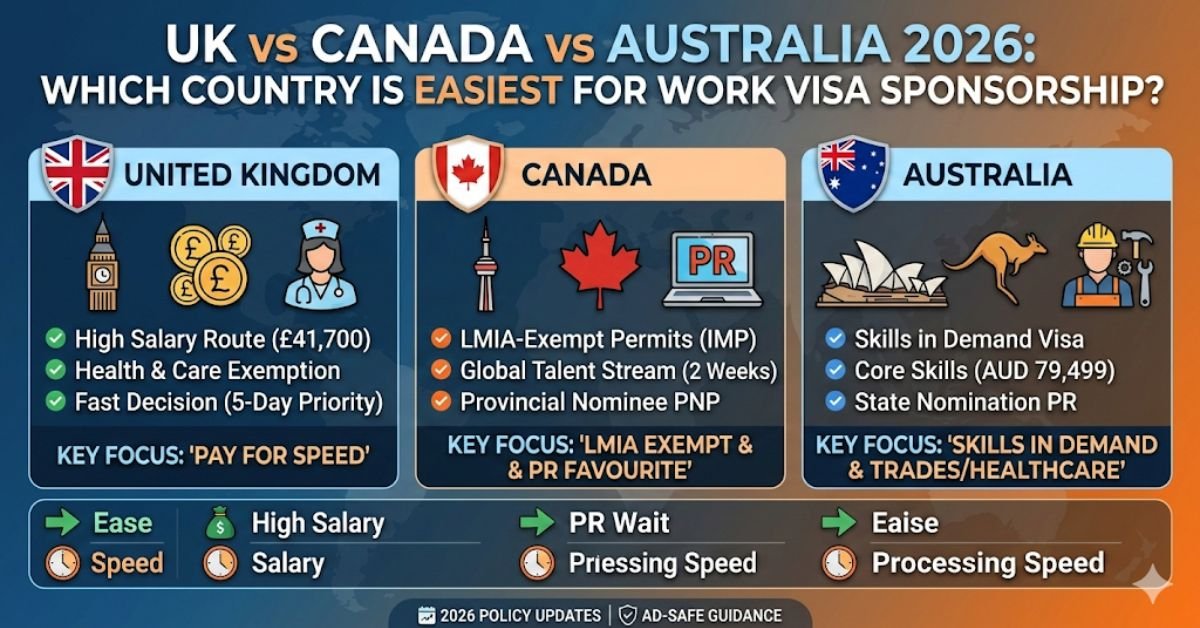
The UK has shifted from a mass migration model to a high value system. If you have a high paying job offer, the UK is arguably the fastest place to get a visa.
The 2026 Shift: High Salaries & Home Office Compliance
The UK Skilled Worker Visa 2026 is now anchored by a New Salary Threshold of £41,700. This is a massive jump that has effectively closed the door on many entry level roles. However, it’s not all bad news.
The ISL Advantage: If your job is on the Immigration Salary List (ISL), your threshold drops to £33,400.
Health and Care Worker Visa updates: This remains the most accessible route with much lower salary requirements (around £29,000–£31,300), provided you have a valid Certificate of Sponsorship (CoS).
Speed: With Priority services, you can get a decision in 5 days, making it the king of processing times.
Pro Tip: Focus on Home Office Compliance 2026 guidelines. UK employers are now under heavy scrutiny, so ensure your sponsor is a “Grade A” license holder to avoid RFE (Request for Evidence) delays.
2. The Canada Pivot: Why LMIA Exempt is Your Best Bet
Canada was once the easy route for PR, but 2026 has brought a massive reality check. The Temporary Foreign Worker Program (TFWP) is currently facing some serious tough love from the government. With nearly 27% of spots slashed, the old ways of getting in are drying up. However, if you look closer, the International Mobility Program (IMP) is absolutely booming. The smart move now? Forget the TFWP and focus on LMIA-Exempt Work Permits.
The High-Speed Lane (GTS): If you’re a specialist in AI, Cybersecurity, or high-end Engineering, you aren’t just a number. Under the Global Talent Stream (GTS), you can literally land a work permit in as little as 2 weeks. It’s the closest thing to a Golden Ticket in 2026.
Targeted Selection (TEER 0 & 1): IRCC is no longer just handing out invites to everyone. They are laser-focused on TEER 0 & 1 Skilled Occupations. Management and professional roles are the primary bait for the latest Express Entry Category Based Draws.
The Provincial Shortcut: Don’t get stuck in the federal backlog. The Provincial Nominee Program (PNP) 2026 is where the real action is. Provinces like Ontario and BC are now bypassing national delays to nominate talent directly for their own local shortages. If a province wants you, you’re in.
3. Australia: The Skills in Demand Era
Australia has officially closed the chapter on the old TSS 482 visa, replacing it with the much-anticipated Skills in Demand (SID) Subclass 482. This isn’t just a name change; it’s a total shift toward a three tier system designed to get skilled workers into the country faster than ever before. If you’ve got the right expertise, Australia is currently offering some of the most stable pathways to Permanent Residency (PR) we’ve seen in a decade.
Cracking the Core Skills Code
Australia is currently desperate for boots on the ground, with a massive focus on healthcare, infrastructure, and the digital economy.
Core Skills Stream (The Main Highway): This is where most applicants will find their fit. To qualify in 2026, you need a job offer on the Core Skills Occupation List (CSOL)which now covers 456 high demand roles and a minimum Income Threshold of AUD 76,515 (Note: This is set to rise to AUD 79,499 from July 1, 2026). This stream grants a 4-year visa and, crucially, a simplified 2-year pathway to PR.
Specialist Skills Stream (The Fast Track): For the high earners and niche experts (excluding trades and machinery operators), this stream is a game-changer. If your guaranteed annual earnings are at least AUD 141,210 (rising to AUD 146,717 in July 2026), your visa processing is prioritised with a 7-day median turnaround. It’s the fastest way into the Australian workforce.
The Regional Advantage (Subclass 190/491): Can’t find an employer to sponsor you directly? Don’t sweat it. Australia’s State Nomination programs are the secret sauce. States like NSW, Victoria, and Western Australia are aggressively nominating offshore talent for the 190 (Permanent) and 491 (Regional) visas. By choosing to live outside the major hubs like Sydney or Melbourne, you can often bypass the tougher competition and secure your future much faster.
Pro Tip: In 2026, the Tied to one employer rule has been relaxed. If you lose your job or want to switch, you now have 180 days to find a new sponsor up from just 60 days in previous years. This gives workers massive leverage and peace of mind.
The 2026 Face-Off: Which One Actually Wins?
Look, comparing these three isn’t just about the numbers it’s about your lifestyle goals. But if we’re talking strictly about the “easiest” entry points in 2026, here is the raw breakdown of how they stack up against each other.
| Feature | The United Kingdom | Canada | Australia |
| Best Suited For… | High-earners & Healthcare | Techies & PR Hunters | Trades & Medical Pros |
| Minimum Pay (Base) | £41,700 (Standard) | Prevailing Market Wage | AUD 79,499 (Core) |
| Processing Speed | 1–3 Weeks (Fastest!) | 2–8 Weeks | 1–4 Months (Slowest) |
| The PR Wait | 5 Years (ILR) | 1–3 Years (The Express Lane) | 2 Years (Subclass 186) |
Which Country Should You Choose?
Choose the UK if you have a job offer ready and want the fastest processing in the world.
Choose Canada if you want the most secure and transparent path to a Passport/PR without being tied to one employer forever.
Choose Australia if you are in a skilled trade (Plumbing, Electrical, Teaching) and want the highest minimum wage and quality of life.
Quick Answers: Cutting Through the 2026 Visa Noise
Q: Is a degree mandatory for visa sponsorship this year?
A: Not necessarily. While degrees help, they aren’t the only way in. In 2026, Australia’s Core Skills Stream and the UK’s Health and Care route are much more focused on what you can actually do. If you have solid, verifiable work experience, it can often act as a direct substitute for formal education. It’s about your skills, not just your diploma.
Q: Which country is easiest on the pocket for immigration?
A: It’s a bit of a trick question. On paper, the UK’s initial filing fees look cheaper, but don’t let that fool you. Once you add the Immigration Health Surcharge (IHS), the costs skyrocket over time. If you’re looking for the best long-term value, Canada remains the most cost effective, especially for those aiming straight for Permanent Residency (PR).
Final Verdict:
Looking at the Global Shortage Occupation List 2026, it’s clear that while the world is desperate for talent, they’ve become incredibly picky about who gets in. Gone are the days of general applications; today’s market is all about niche expertise. If you want a Yes from immigration, don’t just throw your CV at every opening find your specialisation and own it. In 2026, being a specialist isn’t just a title, it’s your only real ticket across the border.
Disclaimer:
Immigration rules are moving fast in 2026, and while we’ve done the heavy lifting to keep this guide accurate, it’s strictly for informational use and not official legal advice. We aren’t affiliated with any government body, so please verify the latest salary thresholds and policy shifts on official Gov sites before making any financial moves. Policy playbooks can change overnight, and we aren’t liable for any visa decisions or costs incurred based on this content.