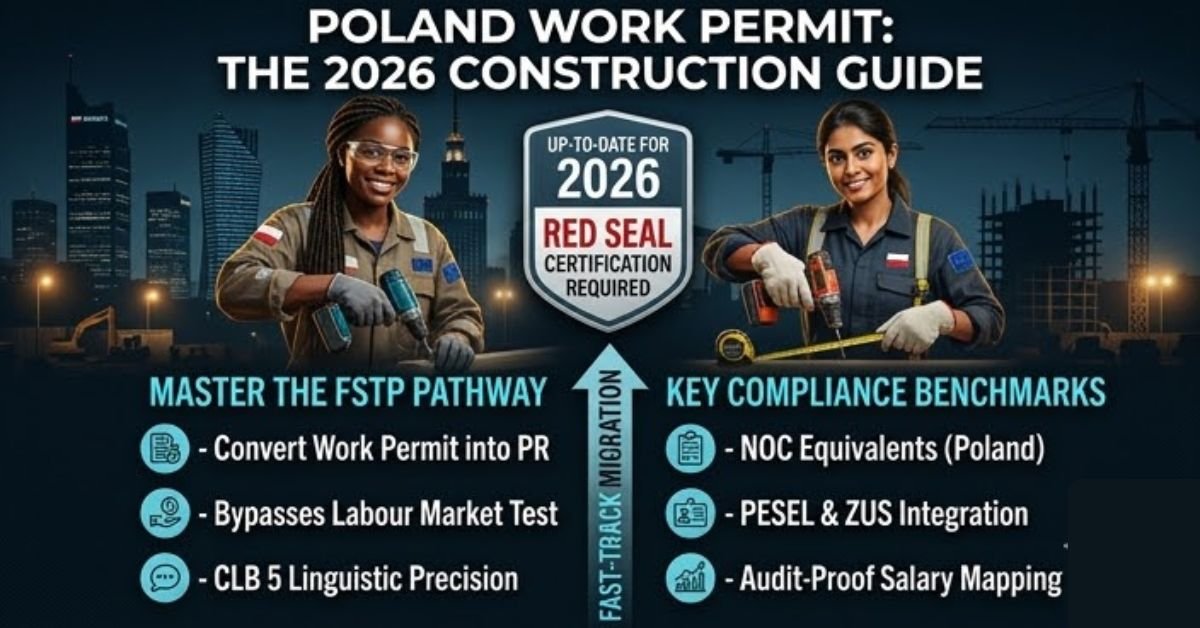
Poland Work Permit: Why Construction Workers are Moving to Warsaw in 2026
In the current 2026 economic landscape, Poland has emerged as the primary Industrial Gravity Well of Central Europe. While legacy migration hubs like Germany face administrative stagnation and complex immigration hurdles, Warsaw has pivoted toward an aggressive Infrastructure Modernization phase. For global tradespeople, the Poland Work Permit 2026 is no longer just a document it is a strategic entry into a high yield Career Legacy Europe.
Following the recent Labor Market Test Abolition 2026, the Trust Gap that once paralyzed offshore hiring has been bridged by the Praca.gov.pl Digital Portal. If you are a specialized technician, welder, or heavy equipment mechanic, the transition to Warsaw is now a matter of Logistical Foresight rather than bureaucratic luck.
1. The Warsaw Surge: Infrastructure Modernization & CAGR
Warsaw’s skyline is currently undergoing a Residential Development CAGR (Compound Annual Growth Rate) surge that outpaces almost every other EU capital. This isn’t just about building apartments; it’s about Prefabricated Housing Projects and massive Warsaw Industrial Logistics hubs designed for the 2030 horizon.
Why 2026 is the Golden Year for Poland Migration:
- Systemic Backlog Bypass: Poland has operationalized a Fast Track Migration System specifically for those listed in the Shortage Occupations List 2026. This reduces waiting times from months to mere weeks for verified trades.
- Zero-Trust Vetting: By using the Praca.gov.pl Digital Portal, every employer sponsorship is verified forensically. This eliminates the risk of synthetic job offers and ensures that your Employer Sponsorship Verification is 100% authentic before you even apply for a visa.
- EU Blue Card 2026 Access: New thresholds have made the Blue Card accessible to highly skilled tradespeople. If your technical expertise is matched with a competitive salary, you aren’t just limited to Poland; you gain a gateway to the entire European Union.
2. Technical Benchmarks: 2026 Workforce Compliance Table
To survive the Poland National Visa (Type D) audit, your professional dossier must meet the latest ZUS Registration (Social Security) and Mandatory Health Insurance Poland standards. Failure to align with these benchmarks can result in a Systemic Flag and immediate visa refusal.
| Compliance Metric | 2026 Operational Benchmark | Strategic PR Impact |
| Minimum Wage (Construction) | 4,300 PLN – 5,500 PLN (Gross) | Mandatory Compliance Floor |
| Visa Type | Poland National Visa (Type D) | Allows 365-day Residency |
| Work Authorization | Voivodeship Office Permit | 3-Year Operational Validity |
| Legal Identity | PESEL Number | Essential for Banking & Tax |
| Trade Certification | Certificate of Qualification | Triggers High-Yield Salary Brackets |
| Compliance Portal | Praca.gov.pl | Automated Vetting Interface |
3. High Velocity Zones: Strategic Industrial Demand & Trade Mapping
The Industrial Electrician Warsaw sector and the acute Specialized Welder Shortage have compelled Polish authorities to operationalize a rigorous NOC Equivalent (Poland) mapping system. This technical framework ensures that your offshore expertise is recognized with forensic precision, serving as a powerful Technical Mechanism for commanding premium salary brackets during wage negotiations.
Priority Recruitment Sectors for the 2026 Cycle:
- Heavy Equipment Mechanics (Structural Backbone): These specialists are the primary drivers of the Infrastructure Modernization Poland projects. From high torque tunnel boring machines to specialized heavy lift cranes, the demand for verified mechanics has reached an all time high, triggering Fast Track Migration pathways.
- Industrial Electricians (Grid Integration): Operational focus is rapidly shifting toward Smart Grid Integration within the sprawling new Warsaw Industrial Logistics hubs. Proficiency in EU Electrical Standards is now a mandatory prerequisite for those seeking long-term Administrative Resilience.
- Prefabricated Housing Technicians: To neutralize the national housing deficit, Poland is aggressively pivoting toward modular and prefabricated construction frameworks. Technicians who command these specialized systems are being prioritized under the Zero Trust Vetting protocol for immediate placement.
4. The Vetting Protocol: Master the Voivodeship to PESEL Sequence
Achieving success in the 2026 migration cycle necessitates an uncompromising adherence to the Voivodeship Office Permit sequence. Poland has now fully transitioned into a Zero Trust Vetting environment, where every Work Experience Verification is cross referenced against global industrial data-hubs. This forensic approach is designed to maintain the integrity of the labor market by eliminating fraudulent entries and identifying high yield industrial assets.
Mandatory Operational Sequence:
- Employer Sponsorship Verification: The protocol initiates at the Praca.gov.pl portal. Your prospective employer is required to register a formal intent to hire, which generates a unique, encrypted tracking code for the Polish consulate. Without this digital anchor, the Poland National Visa (Type D) application cannot proceed.
- Voivodeship Permit Issuance: The local Governor (Voivode) must authorize your work permit based on regional industrial requirements. Thanks to the Labor Market Test Abolition 2026, this phase has been streamlined into a Fast Track Migration lane for tradespeople, significantly reducing the standard administrative lead times.
- PESEL & ZUS Integration (The 72 Hour Window): Upon arrival in Warsaw, the first 72 hours are operationally critical. You must secure your PESEL Number (Universal Electronic System for Registration of the Population) to activate your Mandatory Health Insurance Poland and satisfy ZUS Registration requirements. This is a non-negotiable step for legal salary disbursement.
- Credential Authentication (NOC Equivalent): To command remuneration above the statutory minimum floor, your trade certifications must be authenticated via the NOC Equivalent (Poland) framework. This forensic validation is the primary differentiator between general labor and specialized industrial assets in the 2026 workforce.
5. Strategic Salary Mismatch: Neutralizing the Refusal Trap
In the 2026 regulatory climate, a significant percentage of Poland Work Permit denials are triggered not by a lack of technical skill, but due to a Strategic Salary Mismatch. If your contractually offered remuneration falls below the median for your specific NOC Equivalent (Poland) in the Warsaw sector, the Voivodeship automated system flags the dossier as Potential Exploitation. This systemic trigger is part of Poland’s updated labor protection protocol, designed to maintain industrial wage standards.
To effectively insulate your application, you must execute a Forensic Calibration of your contract to ensure it reflects the 2026 Minimum Wage Poland benchmarks specifically for high velocity skilled trades. This level of Audit Proofing is no longer optional; it is a fundamental prerequisite for long term Administrative Resilience and successful residency transition.
6. FAQ: Clinical and Industrial Migration Intelligence
Q: Is the Labor Market Test still mandatory for construction workers in 2026?
A: No. Under the Labor Market Test Abolition 2026, most construction and technical trades are exempt. This allows for a Systemic Backlog Bypass, meaning employers no longer have to prove they couldn’t find a Polish worker first.
Q: Can I transition from a Poland Work Permit to an EU Blue Card?
A: Correct. If your salary reaches the EU Blue Card 2026 threshold (typically 1.5x the Polish national average), you can pivot to this high-status permit, granting you mobility across the Schengen zone and better PR prospects.
Q: What is the primary cause of Visa Refusals in 2026?
A: Most refusals stem from Employer Sponsorship Verification failures and misaligned ZUS Registration data. Using the official Praca.gov.pl portal ensures your paperwork is forensically aligned with federal mandates.
Conclusion: Architecting Your Industrial Footprint in Poland
By the 2026 operational cycle, the Polish construction market will have fundamentally decoupled from its historical reliance on low-wage, unskilled labor, transitioning instead into a High Performance Technical Ecosystem. Success in this high velocity landscape is no longer an accident of proximity or luck; it is the objective, measurable result of executing a strategic roadmap that prioritizes Administrative Sovereignty.
By mastering the Voivodeship Office Permit mandates and securing a seamless ZUS Registration, you aren’t merely securing a temporary job you are anchoring your professional future within the world’s most resilient construction corridor. In this era of Zero Trust Vetting, those who command the technicalities of Operational Resilience are the ones who successfully convert a standard work permit into a permanent, generational legacy within the industrial heart of Europe.
Disclaimer:
This operational intelligence framework is for strategic orientation and functions independently of formal legal advocacy. Every 2026 IRCC (Equivalent) benchmark and salary threshold in Poland is subject to instantaneous recalibration. To maintain absolute synchronization, always authenticate your professional dossier through the official Polish GOV.PL gateways.