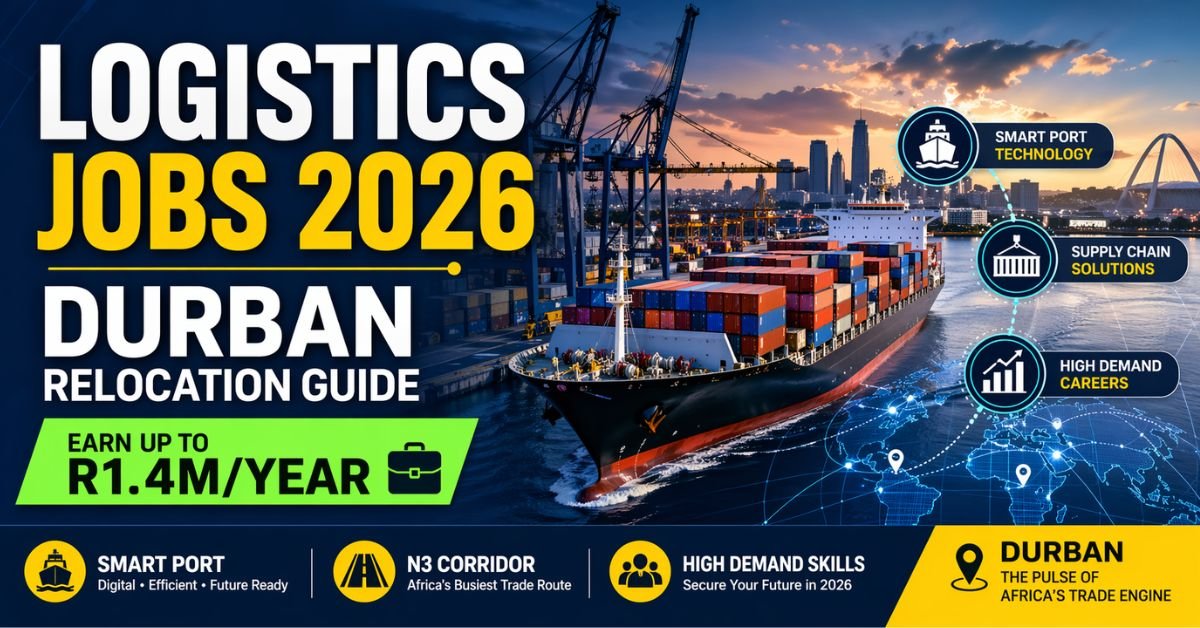
Logistics & Supply Chain Careers in Durban: The 2026 Relocation Roadmap
Durban isn’t just a coastal stop; it’s the strategic pulse of Southern Africa’s industrial machine. Currently handling over 60% of the nation’s containerized cargo, the city has evolved into a high stakes ecosystem for logistics and supply chain veterans.
For specialists in maritime logistics, strategic sourcing, or multimodal freight, moving to Durban in 2026 is no longer a career experiment it is a tactical pivot into a high yield professional landscape. However, the game has changed. We’ve moved past simple warehousing into an era of Technical Synchronization. Your success now hinges on navigating South Africa’s administrative sovereignty with surgical precision.
1. The Durban Edge: Port Natal and the Maritime Shift
Durban is currently in the midst of a multi-billion rand overhaul. Under the Transnet National Ports Authority (TNPA), the facility is aggressively pivoting toward a Smart Port architecture. This isn’t just about new cranes; it’s a digital-first strategy to eliminate historical bottlenecks at Pier 1 and Pier 2. For professionals, this means the demand has shifted from manual oversight to Forensic Data Management.
Durban’s Critical Funnels for 2026
- Durban Container Terminal (DCT): As the busiest terminal in the Southern Hemisphere, the DCT is killing off traditional paper trails. The priority for 2026 is on Freight Handling and Clearing specialists who can navigate high-volume digital manifests with forensic accuracy. If you can bridge the gap between physical cargo and real-time data, you are an Urgent Priority asset.
- Durban Car Terminal: This is the undisputed hub for automotive export. 2026 has brought a specific surge in demand for specialized fleet management, specifically for Electric Vehicle (EV) components and lithium-ion safety protocols. The technical knowledge required to handle these hazardous yet high value goods is currently commanding a massive salary premium.
- Breakbulk Operations: Handling complex project cargo like oversized industrial drills or massive turbines is a specialized craft. Unlike standardized containers, breakbulk requires insider grit. If you have the technical background to manage these high-friction movements, your skill set is in the top 1% of the market.
2. N3 Corridor: Cracking the “Inland Port” Strategy
Living and working in Durban isn’t just about watching ships dock; it’s about owning the Inland Sovereignty of the N3 Corridor. This stretch of tarmac linking Durban to the Gauteng engine room is, quite literally, the most important trade artery in Africa.
By 2026, the industry’s obsession has moved toward one goal: killing Logistics Friction. We’re talking about those brutal, systemic delays that bleed margins dry between the harbor and Johannesburg’s distribution centers. If you can’t navigate the bottleneck politics of the N3, you aren’t managing a supply chain you’re just watching it stall.
High Value Career Hubs for 2026
If you’re looking for where the actual money and stability are moving, keep your eyes on these three anchors:
- Dube TradePort (SEZ): Right next to King Shaka International (KSIA), this isn’t just a tax haven anymore. It’s become a high-velocity hub for cold chain air freight and sensitive electronics. If your background is in Just in Time (JIT) delivery for high-value cargo, this is where you want to be.
- Cato Ridge Inland Port: This Dry Port was built for one reason: to stop Durban harbor from choking on its own volume. They are currently hunting for Intermodal specialists people who understand how to flip cargo from sea to rail without it sitting in a yard for three days.
- The Great Road to Rail Pivot: The government is finally getting aggressive about moving heavy freight off the asphalt to save what’s left of the roads. This has created a massive Talent Vacuum. There is a desperate need for engineers who can actually synchronize Transnet’s rail schedules with private trucking fleets in real time.
The Reality: In 2026, being a generalist in South African logistics is a death sentence for your salary. The premium is on those who can bridge the gap between legacy rail and modern digital tracking.
3. The 2026 Fiscal Matrix: Salary Benchmarks
For anyone eyeing a South Africa relocation, the Department of Home Affairs’ Critical Skills Work Visa is your primary gateway. In 2026, Supply Chain and Logistics roles dominate this list because the country is desperate to fix its supply chain bottlenecks.
| Job Category | Priority Level | Core Competencies | Avg. Salary (ZAR) |
| Supply Chain Manager | Urgent | Strategic Sourcing, ERP Integration | R850k – R1.4M |
| Logistics Engineer | High | Multimodal Ops, Lean Six Sigma | R700k – R1.1M |
| Procurement Specialist | High | Global Sourcing, B-BBEE Strategy | R650k – R950k |
| Freight Forwarder | Medium | Customs Compliance, SARS Logistics | R500k – R800k |
Note: Having your foreign qualifications pre-vetted by the South African Qualifications Authority (SAQA) is now a mandatory survival requirement. Without this digital vetting, your visa process will stall at the first gate.
4. The B-BBEE and Forensic Compliance Barrier
Success in the South African market requires deep expertise in B-BBEE (Broad-Based Black Economic Empowerment). This isn’t just paperwork; it’s a strategic framework. Understanding how B-BBEE levels affect procurement and fleet management is a mandatory skill for any senior leader.
If you can navigate these social quotas while maintaining high yield logistics, you become an Urgent Priority asset for SA firms. Professionals who can integrate B-BBEE strategies into global supply chains are currently seeing a 20% premium on salary offers in Durban. This is the hidden skill that separates high earners from the rest.
5. The Forensic Roadmap: Your Visa Strategy
Step 1: SAQA Vetting (Pre Arrival Phase)
Submit your degrees and professional certifications to the South African Qualifications Authority. In 2026, this digital verification is the non negotiable first gate. Without a SAQA evaluation certificate, your Critical Skills application cannot even be lodged at the consulate.
Step 2: Consular Vetting (Secure Entry)
Once you have a valid offer from a Trusted Employer, apply at the South African consulate in your home country. This secures your Type D Entry Visa, which serves as your legal bridge to the Durban port city.
Step 3: VFS Global Entry (Post-Arrival Sync)
The clock starts the moment you land. You must report to a VFS Global center within 10 days. This step triggers your physical residency permit and formally activates your work authorization in the national database.
Step 4: Fiscal Anchoring (SARS & Banking)
Finalize your presence by opening your tax file with SARS (South African Revenue Service) and securing a local bank account. Until this is linked to your work permit, your professional presence remains structurally fragile and you cannot be legally remunerated.
6. Operational Resilience: Settlement and Housing
Your professional footprint is only as strong as your residential anchor. When relocating to Durban, safety and proximity to the industrial hubs are the two biggest factors to consider.
- Umhlanga: The premier choice for high-tier professionals. It offers modern gated estates and is very close to the Dube TradePort.
- Ballito: A rapidly growing coastal town favored by families who want a lifestyle-first environment near King Shaka International Airport.
- Berea & Morningside: Ideal for those who prefer historic charm and want to stay within 10 minutes of the Durban Container Terminal (DCT).
7. Durban Job Market: The Insider FAQ
Q: Do I actually need a South African degree to land a senior gig?
A: Honestly? No. But here is the catch: your foreign papers must have a SAQA evaluation certificate. Without that, you’re invisible to HR. Durban’s big players actually prefer port hop experience if you’ve managed high-velocity logistics in places like Dubai, Singapore, or Rotterdam, you’ll carry more weight than someone with a local diploma but no international exposure.
Q: Is the AfCFTA just hype, or does it actually help my career?
A: It’s a massive career play. While the African Continental Free Trade Area technically removed borders, it actually cranked up the customs complexity. In 2026, if you are a specialist who can navigate the nightmare of SARS customs regulations and cross-border trade hurdles, you aren’t just an employee you are an elite asset. Companies will pay a premium to anyone who can stop their cargo from getting stuck at the frontier.
Q: What is the one Expats Only hurdle I should look out for?
A: It’s what we call Forensic Friction. You are going to hit bureaucratic walls with port clearing and visa renewals that feel like they make no sense. The only way around this isn’t through emails it’s through mastering the digital platforms used by Transnet and Home Affairs. If you can’t handle the administrative software yourself, the red tape will eat your productivity alive.
Conclusion: Securing Your Career Anchor
Moving to Durban in 2026 is a move toward Industrial Sovereignty. By mastering the forensic friction points of maritime logistics and aligning your career with SEZ benefits, you can bypass the general labor crowd and secure a high-impact role in the heart of Africa’s trade engine. The window for the 2026 cycle is narrow. Start your SAQA vetting today.
Disclaimer:
This guide is built for general info only and is not a substitute for actual legal or immigration advice. While we aim for 100% accuracy, South Africa’s Home Affairs (DHA) protocols and salary thresholds can and do change without warning. Before you hit submit on any application, you must cross verify everything through the official VFS Global portals. We aren’t liable for any application rejections or sudden policy shifts made by the South African government during the 2026 cycle. The final responsibility for your move sits squarely with you.