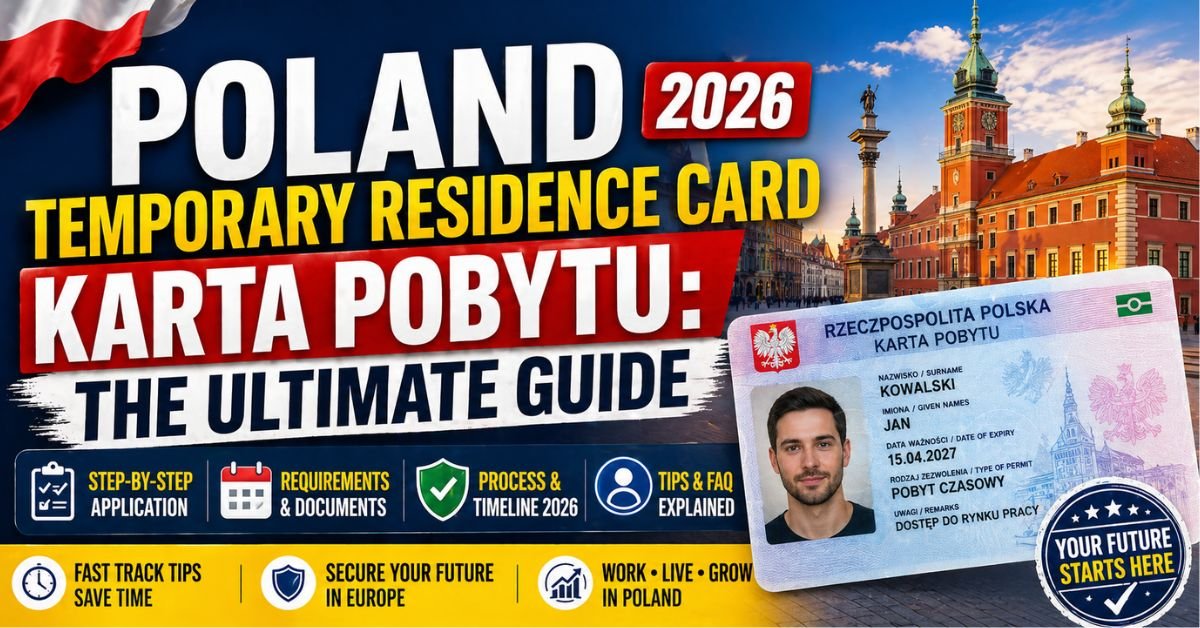
Poland Temporary Residence Card (Karta Pobytu): The Ultimate 2026 Guide
Securing a future in the heart of Europe has shifted from a bureaucratic chore to a high stakes operational campaign. It all hinges on one increasingly rigid document: the Temporary Residence Card, or Karta Pobytu. As of 2026, Poland has tightened its administrative screws to an unprecedented degree, effectively killing the era of vague or hand wavey dossiers. Today, the Urząd Wojewódzki (Voivodeship Office) isn’t just checking boxes; they are demanding a level of digital precision and forensic adherence to Zezwolenie na pobyt czasowy protocols that catches even seasoned expats off guard.
Whether you are a high tier developer or a specialized trade professional, your margin for error has effectively vanished. To succeed in this climate, you must do more than just apply; you have to outmaneuver aggressive new salary benchmarks and master the system’s latest mechanical updates and mandatory digital filing interfaces. This guide cuts through the noise, breaking down the essential, high stakes requirements you need to anchor your stay and professional future within Poland’s rapidly shifting, 2026 economy.
1. The 2026 Pivot Structural Changes to the Process
In the first quarter of 2026, the Polish immigration landscape underwent a significant digital overhaul. The introduction of the Digital Submission Process via the revamped Przybysz/MOS portal has effectively eliminated the grace period for errors. While the physical visit for biometric data collection remains mandatory, the preliminary gatekeeping is now governed by an automated algorithm. This system performs a forensic scan of your Zalącznik nr 1 (Annex 1), flagging omissions or logical inconsistencies the moment you hit submit.
The Hard Stop Update: For 2026, the Minimum Wage Requirement has been aggressively adjusted to track recent inflationary spikes. To secure a Pobyt czasowy i praca (work-based residence permit), your gross salary must now clear a new national floor typically ranging between 4,600 PLN and 5,000 PLN depending on your specific sector code. This isn’t just a guideline; it is a rigid legal threshold designed to ensure that every permit holder remains entirely independent of Poland’s social assistance framework.
2. Navigating the Forensic Sequence: Your TRC Roadmap
The quest for a Karta Pobytu is a marathon of endurance, not a quick sprint. Understanding the Forensic Sequence of your application is often the only thing standing between a successful Decyzja (Decision) and an outright rejection.
The Phased Execution
I. Digital Initiation (MOS Portal) Day 1: The process officially begins with an electronic filing. This isn’t just a form; it’s the moment you generate your case number and lock your position in the administrative queue. You must ensure a high-resolution scan of your Employment Contract (whether Umowa o pracę or Umowa zlecenie) is uploaded immediately to avoid system-generated delays.
II. Biometric Integration Weeks 4 to 8 Once summoned to the Urząd Wojewódzki, you’ll provide fingerprints and biometric data. This is the critical safety phase where the Stempel (Legal Stay Stamp) is inked into your passport. This stamp is your shield, protecting your legal right to remain in Poland while the gears of bureaucracy turn.
III. The Administrative Audit Months 3 to 6 At this stage, your Case Officer (Inspektor) performs a deep-dive into your Required Documentation. Unless your profession appears on the Critical Skills Shortage List, expect a request for the Labor Market Test (Informacja starosty). This is where most applications stall, requiring proactive communication with your employer.
IV. The Decyzja & Card Finalization Month 6+ Success culminates in a written Decyzja. Once you hold this paper, the final hurdle is the card printing fee. After payment, there is a technical wait of roughly 2 to 4 weeks before you can physically collect the plastic card that anchors your residency.
3. The Required Documentation Checklist: A Forensic View
In 2026, Poland’s immigration authorities have shifted from a general review to a high precision audit. Your Salary Benchmarks must demonstrate not just a high figure but also stable, continuous income. To survive the scrutiny of the Urząd Wojewódzki, your dossier must be operationally perfect.
| Document Category | Specific Requirement (2026 Standards) | NLP Entity / LSI Keyword |
| Legal Authorization | A valid work permit or documented exemption. | Zezwolenie na pracę |
| Contractual Base | Preference for 12+ month validity; must be signed. | Umowa o pracę |
| Social Security | Proof of consistent ZUS/NFZ contributions. | Health Insurance |
| Housing Residency | Minimum 6-month lease; address must match records. | Meldunek |
| Biometric ID | 4 photos (35x45mm) taken within last 6 months. | Biometric Data |
| Statutory Fees | Standard 440 PLN administrative deposit. | Opłata skarbowa |
4. Strategic Filter Busters for the 2026 Landscape
Bypassing Poland’s administrative congestion in 2026 requires more than a clean record; it requires a strategic Filter Buster. As the Urząd Wojewódzki moves toward automated algorithmic processing, the most effective tool in an applicant’s arsenal is a well-articulated Knowledge Transfer Plan (KTP).
This isn’t just a cover letter, it is a binding commitment. A strong KTP proves to the state that you aren’t just filling a vacancy; you are a strategic asset contributing to Poland’s long term economic sovereignty. By outlining exactly how you will train local staff or implement specialized global systems, you transform from a temporary worker into an indispensable strategic partner.
The Blue Card & Critical Skills Advantage
For those targeting the Blue Card EU (Niebieska Karta), be prepared: scrutiny has reached a 10 year high. You must provide bulletproof evidence of your standing either through an accredited higher education degree or five years of high level senior experience documented by specific employment certificates (Świadectwo pracy).
Currently, the Urząd do Spraw Cudzoziemców is aggressively prioritizing Priority Path applicants who fill gaps in the 2026 Critical Skills Shortage List. If your expertise aligns with these three “Fast-Track” sectors, you essentially bypass the standard 8 month wait:
- Renewable Energy: Engineering and site leads focused on the Baltic Power offshore wind projects and the Pomeranian solar corridors.
- Specialized Logistics: Supply chain architects capable of rerouting high-stakes trade flows across Central and Eastern Europe.
- Advanced Manufacturing: Specialists in industrial robotics and ESG-compliant leadership, specifically within the expanding EV battery plants in Lower Silesia.
The Manual Trap: In 2026, your job title must match the NOC (National Occupational Classification) codes with 100% precision. A minor typo or a creative job title, like Happiness Hero instead of HR Manager, will trigger an automatic system freeze. Resolving this requires months of manual intervention from a Case Officer (Inspektor), effectively killing your Priority status.
5. Navigating the Terminy Trap: 2026 FAQ
In the Polish immigration circuit, the word Terminy (deadlines) is often a source of massive frustration. To survive the wait without losing your legal standing or travel freedom, you need to look past the official estimates and understand the ground reality of 2026.
What is the realistic timeline for 2026?
If you are applying in high-density hubs like Warsaw (Mazowieckie) or Wrocław (Dolnośląskie), prepare for a long haul of 6 to 10 months. However, a strategic move to smaller voivodeships such as Opole or Lubuskie can still yield a decision within a much faster 4 month window. The backlog is geo-specific; where you file is just as important as what you file.
Can I cross borders while my application is pending?
This is the most common trap for expats. While the Stempel (Legal Stay Stamp) protects you from deportation and allows you to live and work in Poland, it is not a travel document. It does not grant re-entry into the Schengen zone from abroad. Unless you hold a separate, valid visa or a passport with visa free privileges, leaving Poland means you effectively lock yourself out until your card is issued.
What is the emergency protocol if my application is rejected?
If you receive a negative decision, the clock starts instantly. You have exactly 14 days to initiate the Appeal Process (Odwołanie) through the Wojewoda. Crucial Warning: Do not panic and leave the country immediately. As long as your appeal is submitted within that 14 day window, your stay remains 100% legal until the final second-instance decision is reached.
Conclusion: Your 2026 Career Foundation
The Polish Temporary Residence Card is more than just an ID; it’s your anchor in the European economy. By ensuring your Application Tracking Status is monitored weekly via the Online Portal and keeping your Police Clearance Certificate updated, you significantly reduce the risk of delays.
Disclaimer:
This strategic briefing is strictly for educational and navigational purposes and carries no guarantee of residency approval. It is not a substitute for formal legal counsel. In the volatile 2026 regulatory climate, the Urząd do Spraw Cudzoziemców frequently executes unannounced pivots regarding NOC code alignment and inflationary salary adjustments; therefore, individual case by case verification is mandatory. For high stakes administrative appeals (Odwołanie) or contested Labor Market Tests, we strongly advise bypassing self-filing in favor of a licensed practitioner specializing in the specific mechanical nuances of Polish administrative law.