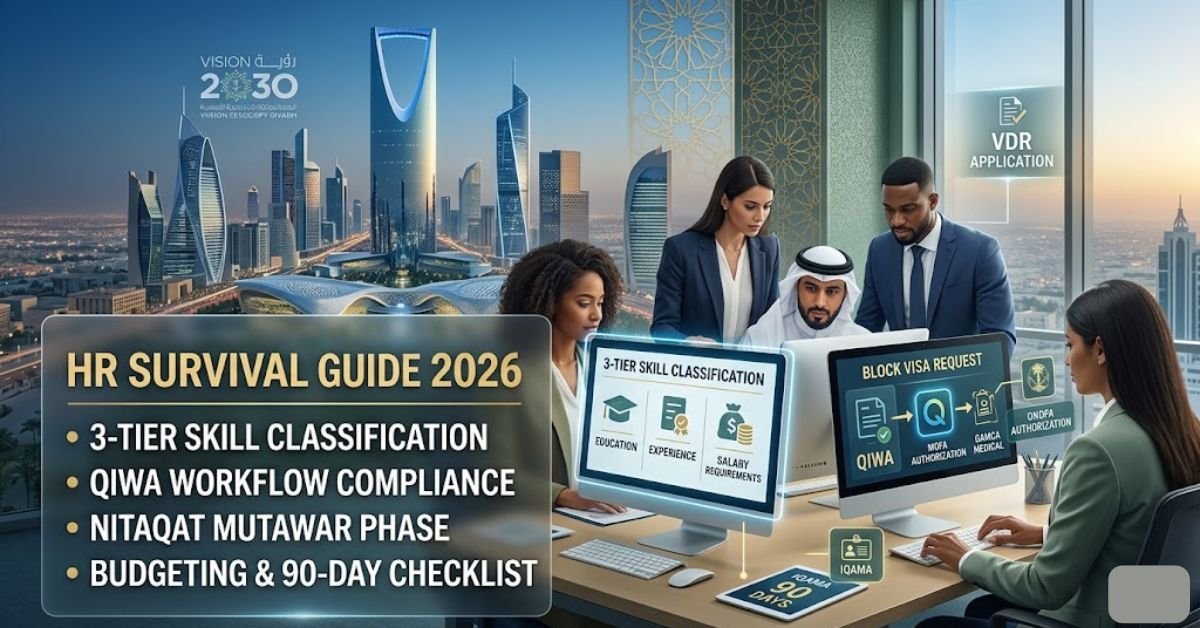
Hiring Foreign Talent: An HR Guide to Saudi Work Visas (2026 Edition)
Landing top-tier global talent is the mission, but let’s be real, the regulations in Saudi Arabia are moving at a breakneck pace. With the Kingdom’s Vision 2030 goals in full swing, your role in HR has literally shifted overnight. You aren’t just a recruiter anymore; you’ve been pushed into the role of a Compliance Navigator. The April 2026 launch of the Developed Nitaqat framework wasn’t just some minor tweak; it introduced a skill based classification that has completely flipped the script on how you bring expats into the country.
If Qiwa platform glitches are giving you a massive headache or Saudi Iqama delays are stalling your entire operation, you’ve landed in the right place. This isn’t some dry corporate manual written by a bot; it’s a 2026 survival guide. We’ve built this as a no-nonsense resource to help you bypass the bureaucratic nightmare and actually get your international hires on the ground before your deadlines expire.
1. The 2026 Shift: Skill Based Visa Classification
Let’s be clear: the era of one size fits all work permits in the Kingdom is officially dead. As of April 2026, the Ministry of Human Resources and Social Development (MHRSD) has pulled the trigger on a three tier system for all Saudi Employment Visas. This isn’t just a label change if you mess up this classification in Qiwa, the system will spit out your application faster than you can hit resubmit.
Here is the breakdown of the new tiers you need to memorize:
| Tier | Requirement Highlights | Min. Monthly Salary |
| High-Skilled | Degree + 5 years exp + 70 pts (HRSD Scale) | SAR 15,000+ |
| Skilled | Vocational/Secondary + 2 years exp | SAR 7,000 – 14,999 |
| Basic | Roles falling outside the above criteria | Under SAR 7,000 |
HR Insider Tip: Don’t even think about trying to game the system. We’ve seen firms try to classify a specialist as Basic just to dodge Nitaqat quotas, and it’s a disaster waiting to happen. Under the strict 2026 labor penalties, a single misclassification can trigger fines of up to SAR 10,000 per head. It’s just not worth the risk.
2. Master the Diamond Track: The Qiwa Workflow
The Qiwa platform is now the absolute backbone of the Saudi labor market. By 2026, the system has reached Total Contractual Transparency. You can’t even dream of a visa without a verified digital contract that proves your company is financially solvent.
Your Step by Step 2026 Checklist:
- Nitaqat Audit: Check your band. The Yellow band was axed in 2026; if you aren’t Green or Platinum, you’re essentially blocked.
- Block Visa Request: Done via Qiwa. You must select the exact skill tier and SSCO code immediately.
- MOFA Authorization: Once approved, get that electronic invitation out through the Ministry of Foreign Affairs (MOFA).
- The GAMCA Medical: Your candidate needs a clean bill of health from an authorized GAMCA center.
- Iqama Issuance: You have exactly 90 days from arrival to flip that entry visa into a full Saudi Iqama.
3. Nitaqat Mutawar Phase: Why 340,000 Jobs Change Everything
The Nitaqat Mutawar Program, which hit the ground running on April 26, 2026, is far from a minor update. It’s a massive structural push to localize 340,000 private sector roles by 2028. If you’re an HR manager in KSA, this is the point where the game gets real. The thresholds have tightened, and the cheap Saudization era is officially over.
- The SAR 4,000 Reality Check: Forget the old 3k baseline. To even count a Saudi national toward your Saudization quota now, their minimum salary must hit SAR 4,000. If you’re paying a single riyal less, that employee basically doesn’t exist in the eyes of the Nitaqat system. This is a huge shift in entry level budgeting that many firms are still sleeping on.
- Mandatory Professional Accreditation: It’s not just about the numbers anymore; it’s about the paperwork. Engineers and other specialized pros now must have their Saudi Council of Engineers (or relevant body) accreditation in place. Plus, there is a new SAR 8,000 salary floor for these roles. No accreditation, no visa, it’s that simple.
4. Budgeting for 2026: The Real Fees
Hiring in KSA is a serious investment. Here’s the updated damage for 2026:
| Expense Item | Estimated Cost (SAR) | Responsibility |
| Visa Authorization (Qiwa) | SAR 2,000 – 7,000 | Employer |
| Iqama (Annual) | SAR 650 | Employer |
| Financial Levy (Mudad) | ~SAR 9,600 | Employer |
| GAMCA Medical | SAR 300 – 800 | Shared/Employer |
| Attestation | SAR 200 – 1,500 | Shared |
The Hidden Reality: Don’t overlook Expat Dependent Visas. While the employee usually covers the SAR 400 monthly fee, HR must ensure the family’s health insurance and school paperwork are ready for a soft landing.
5. HR Survival Checklist: The First 90 Days
Retention doesn’t start in the boardroom; it starts the second your new hire touches down in Riyadh. If you want to avoid those early burnout resignations that kill your ROI, you need to follow this high-stakes timeline religiously.
Days 1–7: The Medical Sprint. Don’t wait. Get them to a local clinic immediately. In 2026, the system is tighter than ever you physically cannot issue an Iqama without a local medical report uploaded to the MOI system. One day’s delay here can push back their entire onboarding by weeks.
Day 15: The Banking & Basics Hurdle. Here’s a pro-tip: While they can’t open a permanent bank account without the physical Iqama card, you should use the Qiwa Compliance Certificate to help them bypass the typical wait for a SIM card and temporary housing. Don’t let your new talent sit in a hotel room feeling disconnected.
Day 30: The Contract Deadline. This is the make or break point. You must ensure the employee’s contract is fully documented and digitally signed on the Qiwa platform. If that digital paper trail isn’t filed by the 30 day mark, that hire basically doesn’t exist for your Nitaqat statistics, and your company’s band color could take a hit.
6. FAQ: Brutal Truths for 2026
Q: Can I let someone start work on a Business Visit Visa?
A: Honestly? No. It’s a massive legal risk. Business visas are for meetings, not production. You need a proper KSA Work Permit for real work.
Q: What if we miss the Iqama renewal?
A: Fines start at SAR 500 and double fast. Even worse, the employee’s bank account will be frozen instantly, causing a massive internal PR disaster.
Q: Is job hopping easier now?
A: Yes, mobility has improved, but most employees still need to finish their first year or their contract term before they can jump ship via Qiwa.
Final Verdict: The 2026 HR Reality Check
Let’s be blunt: hiring in Saudi Arabia isn’t just a talent hunt anymore, it’s a high stakes digital chess match. With the sudden shift to skill-based classification, the MHRSD isn’t just observing from the sidelines; they are actively auditing every single contract and every Riyal that leaves your company’s payroll. If you think you can scale in Riyadh or Jeddah while being reactive to rules, you’re going to hit a massive wall of fines.
My honest advice? Stay glued to the Qiwa platform like your business depends on it because, in 2026, it actually does. You need to keep your Nitaqat status firmly locked in the Platinum zone, and for heaven’s sake, never leave your digital contract documentation until the last minute.
Moving your talent into what we call the Sovereign Safe Zone is the only way to ensure your firm doesn’t just survive but actually thrives in this Vision 2030 era. Keep your paperwork tight, stay sharp, and don’t let a stupid compliance error derail your entire growth strategy. The Kingdom is moving at lightning speed. Make sure you aren’t the one left in the dust.
Disclaimer:
This guide is for general info and isn’t formal legal advice. Saudi labor laws and Qiwa fees can flip overnight, so always double-check the official MHRSD portal before making any big hiring moves. We aren’t responsible for any headaches or fines caused by sudden policy shifts after this was published