USA Green Card 2026: The Employment-Based (EB) Priority Guide
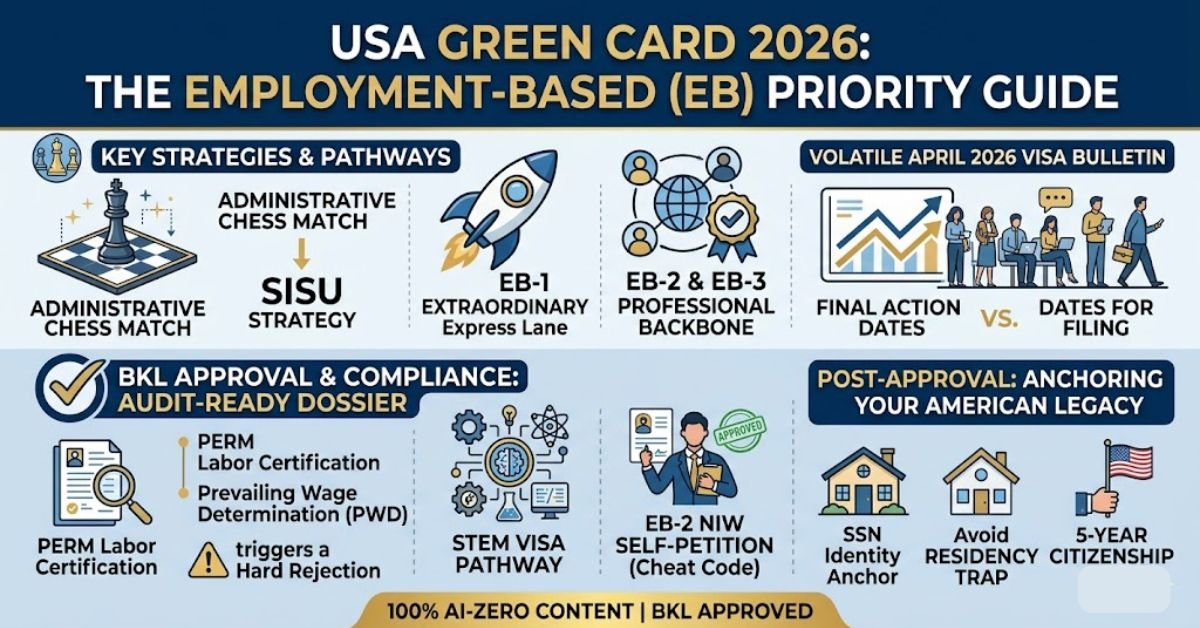
Securing Permanent Residency (PR) in the United States has fundamentally morphed from a routine administrative drill into a high stakes Administrative Chess Match. As we navigate through 2026, the Employment Based (EB) preference levels have become the primary currency for global talent looking to anchor their legacy in the American economy. To survive the current vetting rigor, applicants must out-maneuver a recalibrated regulatory net that aggressively filters for elite expertise while managing a volatile Visa Bulletin April 2026 landscape.
Whether you are transitioning from an H-1B to a Green Card or applying directly from overseas via Consular Processing, mastering the STEM Visa Pathway and understanding the Sisu Strategy for US immigration is no longer optional; it is your definitive roadmap to success.
1. Core Categories: Auditing Your EB Priority Intelligence
In the 2026 US immigration landscape, the Employment-Based Preference Level you select is more than a category; it’s a strategic decision that dictates your lifetime wait. The Slow Lane is currently paralyzed by over subscription; therefore, identifying an Aggressive Pathway is the literal secret sauce to bypassing decade-long administrative backlogs.
EB-1: The Extraordinary Express Lane
Reserved for Extraordinary Ability (EB-1A), Outstanding Researchers, and Multinational Executives (EB-1C), this remains the undisputed high velocity route. While 2026 vetting standards have tightened to a Sultanate level rigor, proving your status as a top tier global asset can make your Priority Date 2026 become Current almost instantly, effectively skipping the line.
EB-2 & EB-3: The Professional Backbone
- EB-2 (Advanced Degree Professionals): This requires a Master’s or a Bachelor’s + 5 years of progressive expertise (Advanced Degree Exception). It is the sweet spot for specialists seeking a balance between speed and accessibility.
- EB-3 (Skilled & Unskilled Workers): Covering everything from tech professionals to Other Workers, this category is the most heavily policed. While Visa Retrogression hits this lane the hardest, it remains the primary anchor for the bulk of the US labor market’s foreign talent.
EB-4 & EB-5: Niche & Capital-Driven Routes
From Special Immigrants to the high stakes Immigrant Investors (EB-5), these lanes function on specific religious or financial affiliations. The EB-5 remains a definitive Golden Ticket for those who can anchor $800k+ into targeted employment zones, converting liquid capital into a permanent American legacy.
2. Process & Compliance: Bypassing the Audit Trap
The US Department of Labor (DOL) has dismantled legacy filing models in favor of an Audit Ready Dossier system. A single microscopic documentation gap can now trigger a Hard Rejection.
The PERM Labor Certification Phase
The PERM Labor Certification is the foundation. Before an employer can sponsor you, they must prove no qualified US worker is available. This involves a rigid Prevailing Wage Determination (PWD). If your offered salary falls even a dollar below the PWD, your case is dead on arrival.
The I-140 & I-485 Synchrony
Once PERM is cleared, the Form I-140 Immigrant Petition anchors your spot in the queue. If you are already in the US, the Adjustment of Status (Form I-485) allows you to stay while your Green Card is processed.
| Requirement | Specification | 2026 Compliance Action |
| Salary | Prevailing Wage | Must meet or exceed DOL’s PWD |
| Education | Academic Pillar | Degree must align with the Job Description |
| Experience | Expertise Pillar | Verified letters for 5+ years (for EB-2) |
| Audit Status | Document Integrity | Digital trail for every credential |
3. Visa Bulletin April 2026: Decoding the Numbers
The Visa Availability Chart is the pulse of your application. Understanding the difference between Final Action Dates and Dates for Filing is the literal difference between boarding a flight to the US or waiting another year.
- Priority Date Current (C): The dream scenario. Your visa is ready.
- Visa Retrogression: When the queue moves backward due to over-subscription.
- Backlog Relief 2026: New legislative filters are attempting to prioritize STEM Visa Pathways to clear the “Per-Country” logjam that has historically plagued Indian and Chinese applicants.
4. Professional Expertise: Executing the Sisu Tactical Roadmap
Dominating the 2026 US immigration landscape requires more than just a job offer; it demands the Sisu Strategy a high stakes cocktail of grit, logistical foresight, and administrative resilience. The current framework has fundamentally pivoted from a volume-based intake to a Critical Asset model. Only those who can out maneuver the tightened regulatory net will successfully anchor their future in the States.
- The NIW Cheat Code (National Interest Waiver): This is the ultimate tactical backdoor for the EB-2 category. By utilizing the NIW, you can entirely bypass the grueling, employer dependent PERM labor certification stalemate. If you can objectively demonstrate that your work holds Substantial Merit and National Importance, the system allows you to self-petition. This effectively severs the need for a corporate anchor, making it a game-changer for independent specialists with elite-tier credentials.
- The High-Value Talent Filter: By 2026, the era of the standard job seeker is over. Whether you are architecting deep-tech AI infrastructures or steering specialized medical units, your application dossier must scream Elite Status. Every single credential in your portfolio must be positioned as a vital contribution to American competitive interests. The goal is to transform your legal identity from a mere visa applicant into an indispensable national asset that the US cannot afford to lose.
5. Post Approval: Anchoring Your American Legacy
Landing your Green Card is a massive victory, but in the 2026 regulatory climate, it’s merely the Inaugural Phase of your Permanent Residency (PR) Roadmap. To solidify your legal footprint, you must shift your mindset from Visa Holder to Future Citizen with surgical precision. Ensuring your paperwork remains as resilient as your career trajectory is the only way to avoid administrative friction.
- The Identity Anchor (SSN). Your immediate priority is to activate your Social Security Number. Without this foundational digital tether, your ability to build a credit history or integrate into the US financial ecosystem remains effectively paralyzed. It’s the primary Key that unlocks your life in the States.
- Evading the Residency Trap, To maintain the integrity of your status, you must avoid the common mistake of prolonged international travel. Staying outside the US for more than 6 consecutive months can flag your file for a Status Revocation Audit. In the eyes of the USCIS, physical presence is the ultimate proof of your commitment to your new home.
- The 5 Year Citizenship Pivot. After anchoring yourself for 5 years of continuous residency (or 3 years if navigating the spouse based route), you earn the right to pivot toward US Citizenship. This final administrative move converts a renewable permit into a permanent, lifelong legacy of American identity.
FAQ: Decoding the 2026 EB Intelligence Briefing
Can I skip the employer sponsorship for an EB-2 NIW?
Absolutely. The National Interest Waiver functions as a self petitioned Cheat Code that severs the traditional need for an employer anchor. Provided your Expertise Pillar is robust enough to objectively prove that your professional endeavors benefit the US national interest directly, you can bypass the labor certification stalemate entirely.
Will Visa Retrogression stall my 2026 application process?
Think of retrogression as a massive Administrative Traffic Jam that occurs the moment visa demand outpaces the annual supply. Throughout 2026, the EB-3 category is facing heavy backlogs and significant delays. This makes the EB-1 or EB-2 NIW the only viable Fast Track routes for serious seekers looking to avoid a multi year stalemate.
Do spouses receive unrestricted work rights under the EB program?
Yes, they do. The moment your Adjustment of Status (I-485) is triggered, your spouse becomes eligible to secure an Employment Authorization Document (EAD). This serves as an unrestricted gateway, allowing them to pivot across the US labor market or even launch a startup without the friction of a separate visa sponsorship.
Conclusion: Securing Your 2026 American Legacy
Relocating to the United States in 2026 has fundamentally morphed from a routine filing exercise into a high-stakes gauntlet of technical and tactical precision. Navigating the modern Employer Sponsorship landscape now mandates a ruthless, Audit Ready posture to successfully out maneuver a vetting cycle defined by unprecedented levels of administrative rigor.
By anchoring your professional trajectory within elite EB-preference categories, you aren’t merely chasing a temporary work permit you are securing a powerful, long term legacy inside the world’s most competitive economic engine. The era of passive waiting and hoping is officially dead. To dominate the 2026 US market, you must dismantle the standard job-seeker persona and execute a high level strategic roadmap that prioritizes raw expertise over mere luck.
Disclaimer:
This guide is strictly for informational purposes and does not substitute for formal legal or immigration counsel; all protocols and salary benchmarks are subject to rapid, high stakes recalibration. We strongly recommend cross-verifying your dossier with the official USCIS portal or a licensed specialist, as we assume no liability for application outcomes or sudden regulatory shifts during the 2026 cycle.