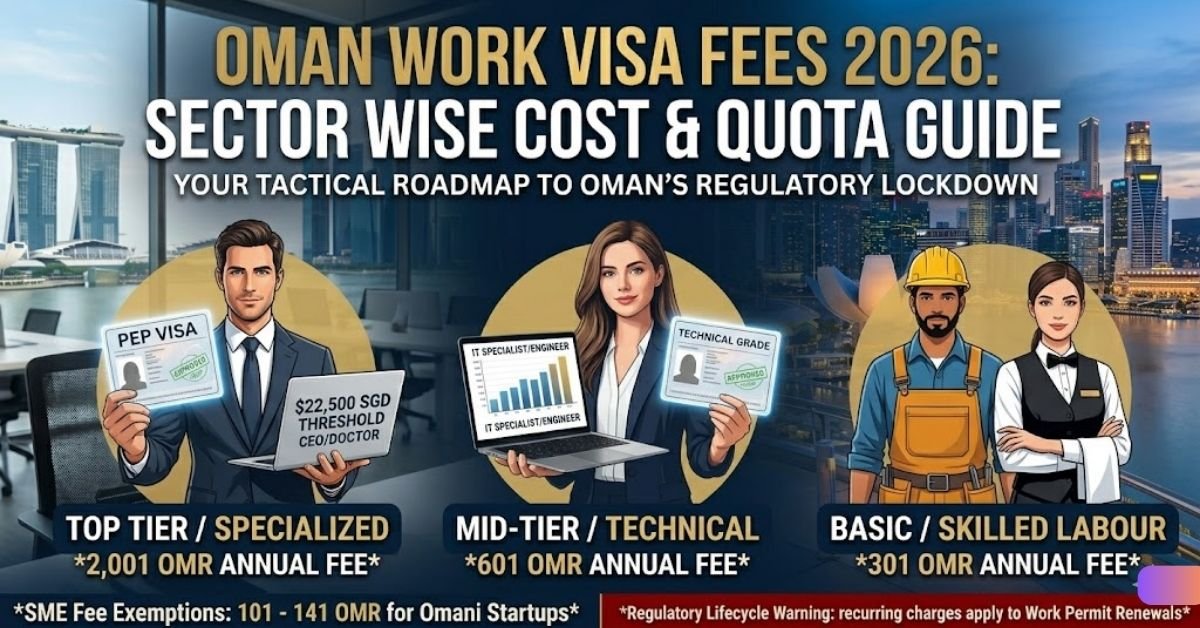
Oman Work Visa Fees 2026: Sector Wise Cost & Quota Guide
Securing a role in the Sultanate today isn’t about the job hunt; it’s about out-maneuvering a highly calibrated administrative machinery. By 2026, the Ministry of Labour (MOL) Oman has pivoted away from legacy hiring models, re engineering the entire fee structure to serve the strict mandates of Oman Vision 2040. For any specialist or entrepreneur, understanding the nuances of Sector Wise Visa Costs isn’t just good to know; it’s the only way to bypass the administrative bottlenecks that now define the region’s recruitment cycle.
The days of simple, flat rate labor permits are dead. In the current climate, the price tag of an Expat Labour Clearance is surgically linked to two things: your professional grade and your employer’s Omanization Quota Requirements. If you aren’t auditing these Omani Rial (OMR) Visa Payment benchmarks with precision, you are essentially operating in the dark within one of the Middle East’s most aggressively policed labor markets.
1. The 2026 Labour Clearance Framework
The Expat Recruitment Permit process in 2026 is a two tier system. Before the Oman Royal Police (ROP) Visa Issuance can even begin, the employer must secure a labor clearance from the MOL.
This clearance is the Gatekeeper of the Omani economy. It ensures that companies are adhering to the Profession Replacement Policy (Omanization). In 2026, if a company fails to meet its local hiring quota, the cost of bringing in foreign talent can skyrocket or the permit may be denied entirely.
2. Sector Wise Visa Costs: 2026 Price List
The Ministry of Labour (MOL) Oman has categorized professions into three main tiers. This graduated fee structure is designed to incentivize the hiring of Omani nationals in administrative roles while allowing high skill expatriates to fill technical gaps.
2026 Expat Labour Clearance Fees (OMR)
| Professional Category | Annual Clearance Fee (OMR) | Key Examples |
| Top Tier / Specialized | 2,001 OMR | CEOs, Senior Managers, Specialist Doctors |
| Mid-Tier / Technical | 601 OMR | Engineers, Accountants, IT Specialists |
| Basic / Skilled Labour | 301 OMR | Hospitality, Construction, and Domestic Workers |
| SME Fee Exemptions | 101 – 141 OMR | Startups with Omani Management |
Regulatory Lifecycle Warning: These statutory charges apply exclusively to the initial Expat Recruitment Permit issuance. Under current Ministry of Labour (MOL) mandates, these costs are recurring, typically cycle synced every 24 months in alignment with mandatory Work Permit Renewal Fees. Failure to audit these biennial renewal costs can lead to significant administrative friction during the residency extension phase.
3. The SME Catalyst: Navigating Strategic Fee Exemptions
In an aggressive bid to rewire the Sultanate’s startup DNA, the 2026 labor framework has integrated a series of high-impact Small and Medium Enterprises (SMEs) Fee Exemptions. This initiative goes far beyond a simple administrative markdown; it serves as a calculated Economic Lever designed to disrupt the traditional corporate monopoly on talent. For any business entity led by Omani entrepreneurs with a validated Riyada database status, the mandatory cost of an Expat Labour Clearance is significantly reduced, often collapsing to a mere fraction of what the market heavyweights pay.
This regulatory buffer functions as a survival mechanism, allowing lean, high growth startups to headhunt global specialists without being suffocated by the predatory overheads that typically plague the recruitment phase. By decoupling visa expenditures from the legacy corporate pricing tiers, the Ministry of Labour (MOL) is successfully de risking the talent entry barrier for Omani-led firms. This ensures that the Oman Vision 2040 agenda remains operational at the grassroots level, enabling small businesses to anchor world-class expertise at a sustainable, low-friction price point.
4. The Boss Fight: Banned Professions & Omanization Lockdown
Before you even calculate the OMR fees, you must confront the Boss Fight of the application process: the Banned Professions for Expats 2026. As a cornerstone of the Sultanate’s aggressive nationalization drive, the Ministry has slammed the door shut on over 200 job titles, reserving them strictly for Omani citizens. This isn’t just a guideline; it’s a hard coded regulatory lockdown.
- Prohibited Zones: Expats are now officially barred from roles in Human Resources (HR), Public Relations (PR), Administrative Assistance, and the majority of Customer Service sectors.
- The Penalty for Misclassification: Attempting to game the system by using a generic title in the Sanad Office Services portal to hide a banned role is a high risk gamble. By 2026, the AI driven vetting system will flag these inconsistencies instantly, leading to immediate permit rejection and heavy fines for Labour Law Compliance 2026 violations.
5. Technical Guardrails: Degree Authentication & Competency Testing
By 2026, the Sultanate has made it clear: your degree is only as valid as the digital trail it leaves behind. Degree Attestation & Qualification Verification is no longer a post-arrival afterthought; it is a mandatory, high stakes Pre Entry bottleneck. If your credentials aren’t verified at the source before you even board your flight, the entire application will hit a dead end.
Beyond the paperwork, the Ministry of Labour (MOL) has introduced a Prove It culture. Certain technical and specialized roles now fall under the Occupational Standard Testing mandate. This means that before your visa clears the ROP portal, you must navigate a practical or theoretical exam at an MOL authorized center. In 2026, technical competence is vetted by examiners, not just resumes.
The Non Negotiable Medical Fitness Protocol
The Medical Fitness Test for Oman Visa remains the ultimate filter. In the 2026 cycle, these protocols have tightened; you must secure a Fit certificate from a GAMCA-approved center in your home country. Don’t expect to skip the second hurdle, though every result is subjected to a mandatory re-verification at an Omani Ministry of Health (MOH) clinic upon landing.
6. Step by Step Logistics: From Sanad to ROP
Navigating the Commercial vs. Non Commercial Work Visas pipeline requires Surgical Precision:
- Quota Verification: The employer performs a Company Labour Quota Check via the MOL portal.
- Clearance Application: Payment of the Sector Wise Visa Costs at a Sanad Office Services center or online.
- Labour Clearance Issuance: Once approved, the electronic clearance is linked to the candidate’s passport.
- ROP Portal: The employer applies for the visa through the Oman Royal Police (ROP) Visa Issuance portal.
- Entry & Civil ID: Upon arrival, the expat undergoes biometrics to receive their Residence Card.
7. FAQ: Cracking the Oman Visa Code 2026
Q: Is it legal for me to bear the visa expenses personally?
A: Absolutely not. Under the current Labour Law Compliance 2026 framework, the employer is strictly mandated to shoulder all recruitment-related overheads. This includes everything from the initial Expat Labour Clearance to the final residency issuance. Any attempt by a sponsor to offload these costs onto the employee is a direct violation of Omani labor statutes.
Q: What is the protocol if I decide to switch employers?
A: A job pivot requires a complete administrative reset. Your new sponsor must initiate a fresh Expat Recruitment Permit and settle the prevailing Sector-Wise Visa Costs. The silver lining in 2026 is that the No Objection Certificate (NOC) system has been significantly streamlined, allowing for much smoother, transparent transfers via any Sanad Office Services hub.
Q: Should I expect a monthly Expat Tax or levy on my salary?
A: Unlike some neighboring Gulf markets, Oman currently sticks to an Upfront Model. Instead of a monthly recurring levy, the government collects a one-time clearance fee at the start of the 2 year cycle. This makes the Omani Rial (OMR) Visa Payment a far more predictable expense for businesses and ensures your monthly take-home pay remains stable.
Conclusion: Beyond the Job Hunt, Engineering a Legacy in Oman
The 2026 economic landscape in the Sultanate has evolved into a high stakes arena, where the Gold Rush is now exclusively reserved for the technically elite. To do more than just survive to actually thrive amidst the 2026 Infrastructure Surge, you must shed the skin of a traditional job seeker.
Success in this market requires you to function as a specialist who can navigate the complex intersection of Oman Vision 2040 mandates and uncompromising global benchmarks. You aren’t just applying for a role; you are positioning yourself as a critical asset within a rapidly transforming national economy. If you can master the regulatory nuances and the fiscal realities of the current visa ecosystem, Oman offers more than just a paycheck it offers a platform for a legacy career.
Disclaimer:
While this 2026 workforce intelligence guide is built on current Ministry of Labour (MOL) protocols, statutory fees and Omanization quotas are subject to immediate regulatory shifts. We strongly advise all professionals and entrepreneurs to cross verify specific permit costs through the official MOL or ROP digital portals before initiating any financial transactions. This roadmap serves as an educational resource and does not constitute formal legal or migration consultancy.